

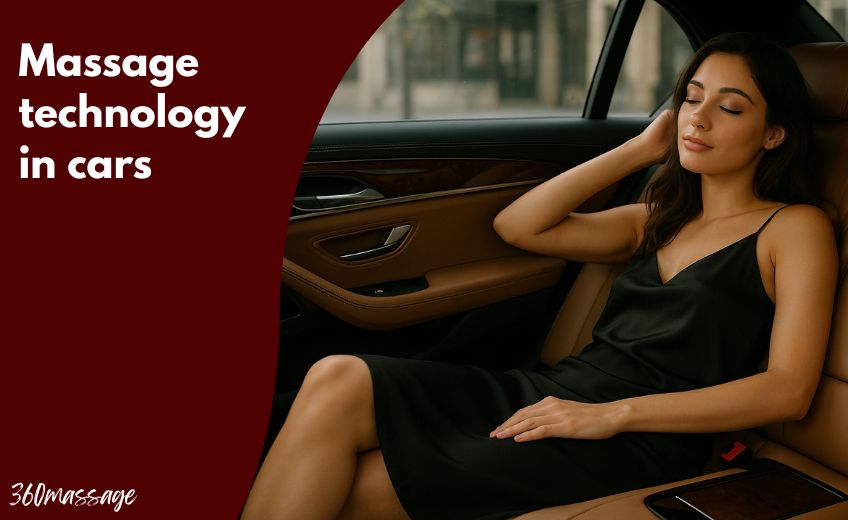
Technology behind massage seats in cars
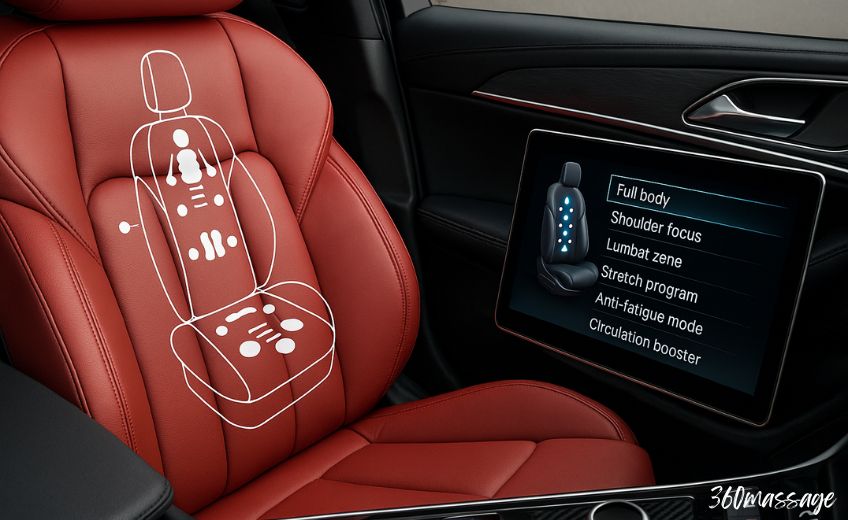
Massage seats in cars use air cushions (and, in a few luxury models, small rollers) hidden in the backrest and seat base. A pump inflates them in timed sequences so they press, knead and roll against your back while you sit upright. They can make long drives more comfortable, but they are low-intensity by design and only reach your back and seat, so they work very differently from a full-body massage chair at home.
Below: how the technology works, what the research measured, which cars offer it and what it costs, and a side-by-side comparison with a home massage chair.
How automotive massage seats actually work
Almost every system combines the same four parts: air cushions, an optional roller unit, heating or ventilation, and software that runs the programs.
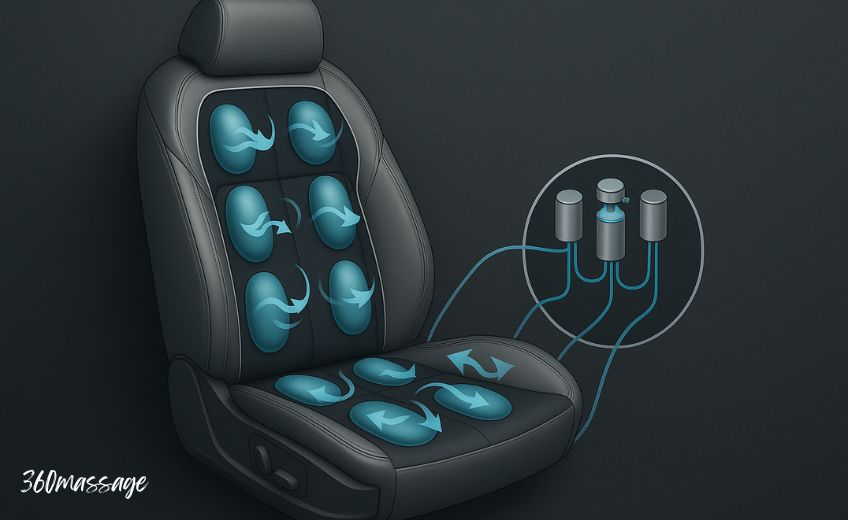
Pneumatic air cushions
Inflatable bladders sit under the seat cover in the backrest and cushion. They fill and empty in patterns to imitate kneading, pressing and rolling (Kelley Blue Book). Audi’s A8 uses 18 separate air cushions, so the seat can work small areas of the back in sequence.
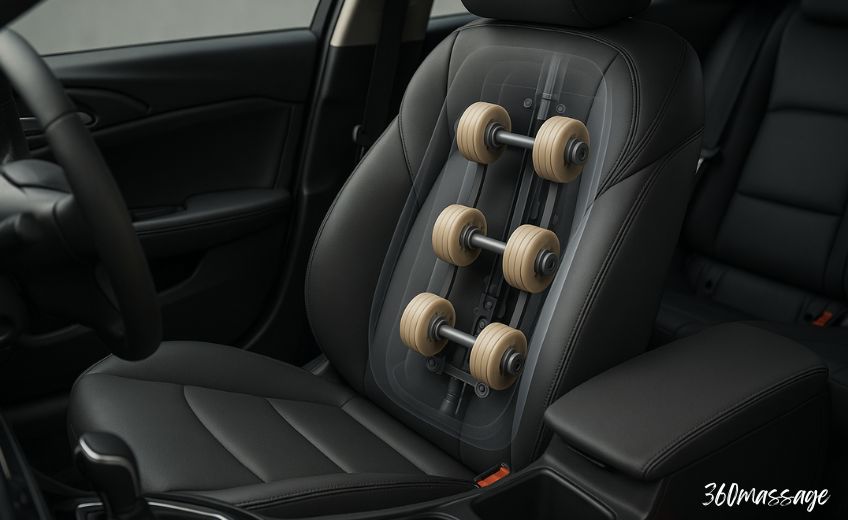
Mechanical rollers
Some high-end seats add motorized rollers. Kelley Blue Book describes the typical menu as “upper rolling, lower rolling, and air pockets” (KBB). The rollers have to fit inside a thin car seat, so their travel and depth are small compared with a massage chair mechanism.
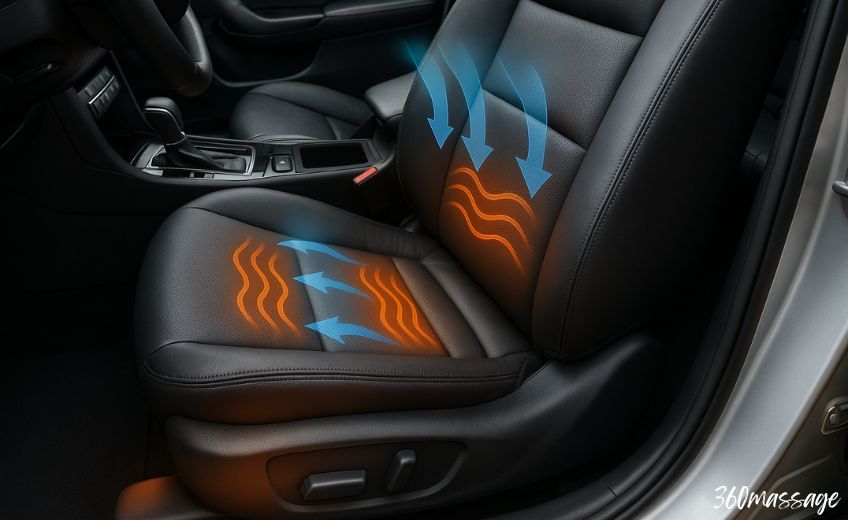
Heat and ventilation
Massage is usually bundled with heated and ventilated seats in the same package. Heat makes the pressure feel softer; ventilation keeps you from sweating against leather on long trips.
Controls and programs
Controls sit on the seat base, the door panel or the touchscreen, where you choose the program, speed and intensity (KBB). See the owner guides from Mercedes-Benz and Cadillac for how real systems are set up. Kia’s Lumbar Stabilization System in the Telluride can switch the massage on by itself every 30 or 60 minutes (KBB).
Where massage seats came from
Massage chairs for the home came first (see how massage chairs were invented). In cars, massaging seats appeared in the late 1990s, first from Mercedes-Benz, Rolls-Royce and Cadillac. Today 16 brands offer them in about 50 vehicles, including the Ford F-150, Hyundai Palisade and Volkswagen ID.4 (KBB).
Which cars have them, and what they cost
- Mostly top trims. Ford, for example, limits massage to its top-level Platinum trims, and the Hyundai Palisade and Kia Telluride offer it on the driver’s seat only (KBB).
- As an option. Porsche’s massage option adds $2,000 to the price of the car (KBB).
- Below luxury prices. Capital One lists six cars with massage seats, each available for about $55,000 or less (Capital One Auto Navigator).
- Aftermarket cushions. Plug-in seat massagers run about $60 to $150 and may need a 12-volt adapter (KBB). We compare them with full chairs in massage chairs vs massage cushions.
What the research says
One peer-reviewed 2011 study tested this directly. Published in the Journal of Manipulative and Physiological Therapeutics, researchers from BMW, TU Delft and the University of Nebraska-Lincoln put a lightweight, low-intensity seat massage system through real driving:
- 20 participants drove a set route around Munich for 120 minutes and rated their comfort.
- 24 participants drove laps on a test track while sensors recorded muscle activity (EMG) in the upper back.
- With the massage running, comfort was higher and muscle activity in the trapezius area was significantly lower.
That supports a modest claim: a massage seat may help your shoulders stay more relaxed and make a long drive feel more comfortable. The study did not test back pain, circulation or driving safety, so claims about those go beyond the evidence. As one UK guide puts it, massage seats “aren’t intended to provide medical treatment,” and they are no substitute for a seat that gives you the right support and driving position (MotaClarity).
Car massage seat vs home massage chair
Car seats have to keep you upright, alert and safe in a crash. A home chair doesn’t, which is why the hardware is so different. Here is a car seat next to our Raha, which we use as the example because its specs are the most complete.
| Massage seat in a car | Full-body home chair (Raha) | |
|---|---|---|
| How it massages | Air cushions; some add small rollers | Rollers on an SL-track with a 1350 mm rail, plus 18 airbags with 3 intensity levels |
| Areas reached | Backrest and seat cushion | Neck down the back and under the seat along the S-and-L track, plus airbags and calf heating |
| Intensity | Low by design | Adjustable roller and airbag intensity |
| Position | Upright driving posture | Reclines to 172° zero gravity |
| Stretching | “Stretch” modes on some models | 2 push rods for Thai-style stretching |
| Programs | A handful of modes | 12 automatic + 8 manual programs |
| Heat | Seat heating and ventilation | Back and calf heating |
| Extras | Tied to the car’s screen and trim | Heart-rate and blood-oxygen readings, wireless and USB charging, English voice guidance |
| When you can use it | Only while you’re in the car | Any time at home |
In short, a car seat takes the edge off a long drive; a chair is for a full session afterwards.

How our chairs compare
If a massage seat on your commute made you want the real thing, these are the differences between the 360massage models that matter most:
| Model | Mechanism | Track | Programs | Stand-out feature | Colors |
|---|---|---|---|---|---|
| Weltron | 5D | SL-track | 22 auto modes | Silicone leather; our flagship | 7 standard + 18-color custom panels |
| Auren | 4D | SL-track | 12 preset programs | ROVO robotic leg / walking simulation | 13 standard + 18-color custom panels |
| Raha | SL-track rollers | SL-track, 1350 mm rail | 12 auto + 8 manual | Thai stretch push rods, 172° zero gravity | 3 |
| Niyak | 4D | ErgoFlex S and L-Track | 8 massage techniques | PU leather; 137 x 82 x 132 cm | 6 |
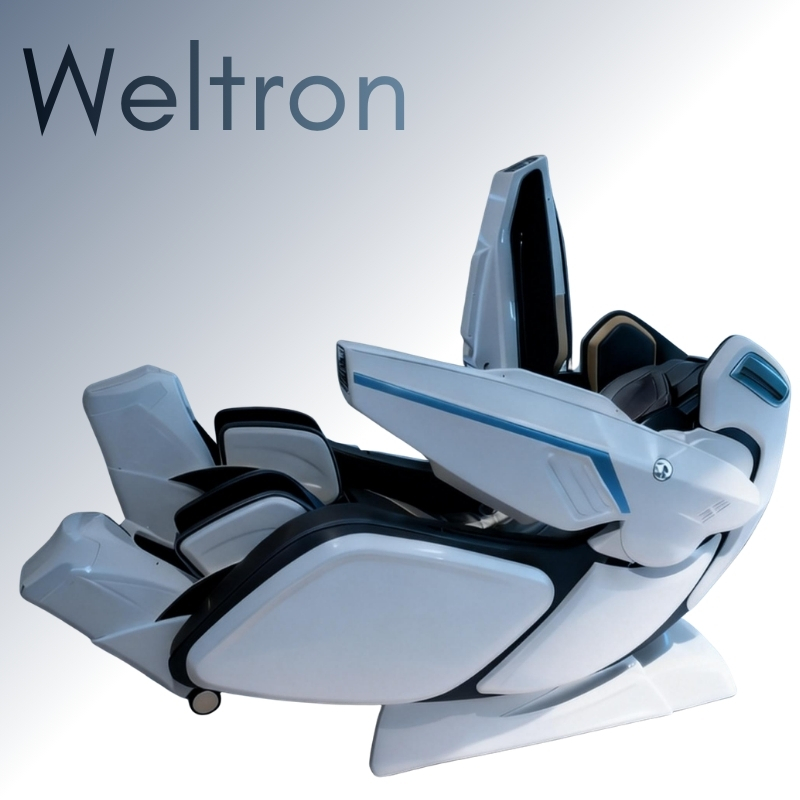
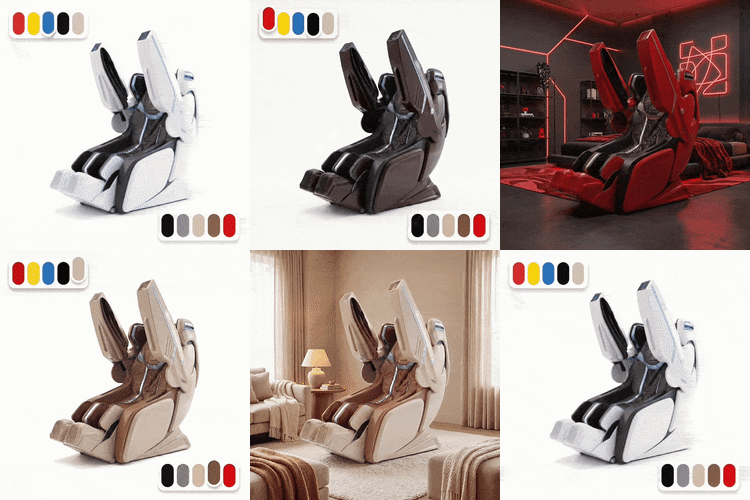
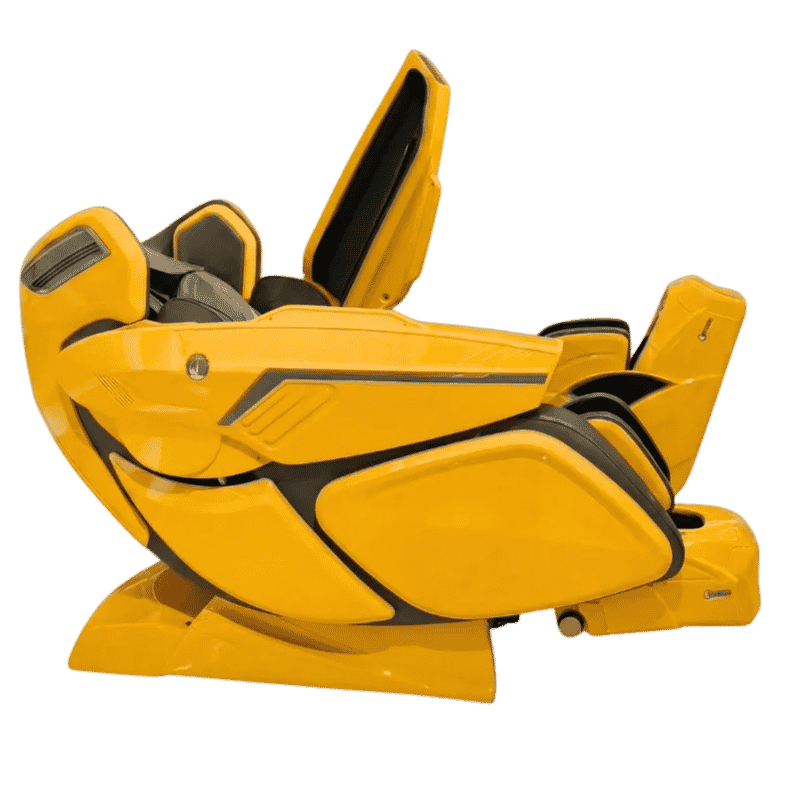
Only the body color can be customized; interior and footrest finishes are fixed. Raha is ready to deliver and arrives in 5-7 days; built-to-order models take 30-40 days. Shipping is free (shipping details), and every chair has a 3-year warranty with free spare parts that starts on the delivery date (warranty) and a 90-day return window (returns).
Who each option is not right for
- Car massage seats are hard to justify if most of your drives are short. Kelley Blue Book argues that paying thousands more just to get them “makes little sense” (KBB). If the seat itself doesn’t fit you, massage won’t change that.
- A home chair won’t help if your stiffness builds up during the drive itself, and it needs a room for it: the delivery route needs an 83 cm (32.7 in) door, or 60 cm (23.6 in) with the side panels removed. It runs on standard 110-240V power with no dedicated circuit.
- A plug-in cushion is the cheaper choice if you only want light back pressure in the car or at your desk, but it can’t recline you or reach your legs.
- Anyone with a medical condition, pregnancy or recent surgery should ask their doctor before using any massage device.
If you’d like the payments spread out, Affirm offers 24-36 monthly payments and Klarna is available at checkout.
And TBH I’m not complaining! Give me heated 4D massage rollers in a traffic jam any day.

Comments
Add a Review
Your email address will not be published. Required fields are marked*
Design Your Chair Yourself


canada pharmaceuticals online
Why viewers still make use of to read news papers when in this technological globe the whole thing is available on web?