
How to choose a (good) massage chair?
To choose a massage chair, check fit and logistics before features: the chair has to suit your body, get through your door, run on your power and come with a warranty and return policy you can live with. Then pick the mechanism (roller type and track) that reaches where you carry tension. Heat, voice control and health readings come last, because most premium chairs now have them.
Use the checklist below to narrow the field. Each line links to a guide that explains that feature in depth, so this page stays short.
The decision checklist
| Check | What to look for | How to verify before you order |
|---|---|---|
| 1. Body size | A track long enough to reach from your neck to your glutes, and a leg rest that extends for your height | Ask for the chair’s user height and weight range; see our guide for tall users |
| 2. Room and doorway | Floor space for the full recline, plus a delivery path wide enough for the chair | Measure every door and hallway on the way to the room; compare with the assembled dimensions, not the carton |
| 3. Power | A chair that runs on a normal household outlet | Check the voltage and rated wattage on the spec sheet |
| 4. Mechanism | Roller type (3D, 4D or 5D) and track shape (S, L or SL) | Read 3D vs 4D and what an SL-track is |
| 5. Budget | The total cost: chair, delivery, financing, and what a return would cost you | Look for shipping fees and restocking fees in the policy pages |
| 6. Warranty and returns | Length, whether parts are included, and when coverage starts | Read the warranty page itself, not the product page summary |
The common buying mistakes behind each of these checks are covered in 8 mistakes to avoid when buying a massage chair.
Start with what you want the chair to do
Most people buy for one of three reasons: winding down after work, easing tight muscles after activity, or a regular massage routine at home without booking sessions. Research on home chairs is modest but encouraging. In a small six-month trial with adults aged 50 to 75, people who used a massage chair twice a day reported better mood and self-rated health than a control group, though cortisol levels did not differ (Baek et al., 2022).
For lower back pain, a randomized trial found that both physiotherapy and massage chair sessions improved pain and function. Physiotherapy did better, while the chair cost about 60% as much, and the authors stated the chair is not a replacement for physiotherapy (Medicine, 2020). So think of a chair as a way to relax and keep a routine going, not as treatment.
If you live with circulation problems, neuropathy, reduced sensation, are pregnant, or are recovering from surgery, talk to your doctor before buying. A chair that is right for most people may not be right for you.
1. Body fit: track length and height adjustment
A chair that does not fit puts the rollers in the wrong place, and no feature list fixes that. Two things matter most:
- Track coverage. An SL-track follows the curve of the spine and continues under the seat, so it reaches the lower back and glutes. Weltron, Auren and Rayan use an SL-track, and Niyak uses an ErgoFlex S and L-Track.
- Body scanning and leg-rest extension. The chair measures your shoulder height before a session and moves the rollers to match. Auren and Weltron also extend the leg rest for taller users. How scanning works is explained in our body scanning guide.
Not a good fit if: you are well outside average height or weight and the seller cannot give you a user range in writing. Ask before you order.

2. Room, doorway and delivery
Most buying guides tell you to “measure your space” and stop there. The two numbers that actually stop deliveries are the doorway width and the chair’s weight. Here are the figures for the two models whose full specifications are published on their product pages:
| Weltron | Auren | Niyak | |
|---|---|---|---|
| Assembled size (L × W × H) | 192 × 95 × 153 cm (75.6 × 37.4 × 60.2 in) | 177 × 95 × 102 cm (69.7 × 37.4 × 40.2 in) | 137 × 82 × 132 cm (53.9 × 32.3 × 52 in) |
| Weight | 176 kg (388 lb) | 133 kg (293 lb) | See product page |
| Minimum doorway | 83 cm (32.7 in), or 60 cm (23.6 in) with the side panels removed | ||
Dimensions are for the assembled chair upright. Leave extra room behind and in front for the recline. Ready-to-deliver models arrive in 5-7 days; built-to-order models take 30-40 days. Shipping is free, and the details are on our shipping page.
Not a good fit if: you move often or plan to rearrange the room regularly. At 133 to 176 kg, these chairs are built to stay put.

3. Power
A home massage chair should run on an ordinary wall outlet. All 360massage chairs run on universal 110-240V power and do not need a dedicated circuit; you choose the plug type when you order. For scale, Weltron’s spec sheet lists a 120 W rating. If a chair you are considering asks for special wiring, factor the electrician into the price.
4. Massage mechanism and comfort features
This is where most guides spend all their words. In short:
- Rollers: 3D rollers move in and out for depth; 4D adds changes in speed and rhythm; 5D is a further refinement of 4D control. The details are in 3D vs 4D and 4D vs 5D.
- Zero gravity: the chair tilts back and raises your legs to spread your weight across the seat and backrest. Weltron and Auren offer three recline angles. See how zero gravity works.
- Heat: standard on all our full body massage chairs, so it rarely decides between two models. More in heat therapy in massage chairs.
- Airbags: they inflate around the shoulders, arms, hips and legs for compression. Auren has 42 and Weltron 37.
- Feet and calves: foot rollers and leg stretch vary more between models than people expect. Our foot massager guide explains the differences.

5. How our models compare
If you are choosing within the 360massage lineup, these are the differences that usually decide it. Every figure comes from the product pages.
| Model | Mechanism and track | Programs | What stands out | Colors |
|---|---|---|---|---|
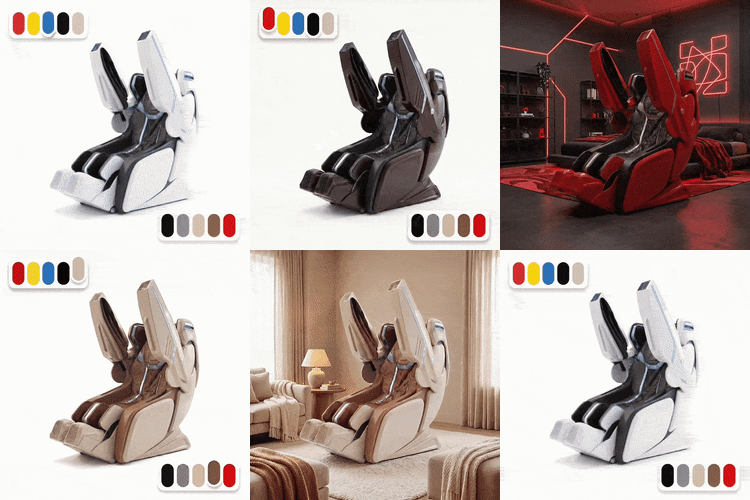
| Weltron (flagship) | 5D, SL-track | 22 auto modes plus manual | 37 airbags, synchronized dynamic armrests, walking-motion foot massage, silicone leather | 7 standard, or 18-color custom panels |
| Auren | 4D, extended SL-track | 12 preset plus manual | ROVO robotic legs that move in a walking rhythm, 42 airbags, hip program, aromatherapy | 13 standard, or 18-color custom panels |
| Ayla | 4D | Auto and manual | Eight anti-pinch sensors and rear obstacle sensors, health check, voice control | 3 |
| Rayan | 4D, SL-track | Auto and manual | Fingerprint pulse check, aromatherapy, wireless charging pad | 2 |
| Niyak | 4D, ErgoFlex S and L-Track | 8 massage techniques | Most compact of the three chairs in the size table, three control options (voice, touch screen, roller dial), PU leather | 6 |
Quick guidance: pick Weltron if you want the deepest program library and the 5D mechanism and have the room for it. Pick Auren if leg and hip work matter most to you. Niyak suits smaller rooms. Weltron is not the right choice for a tight space: it is the largest chair in the size table above.

6. Controls and smart features
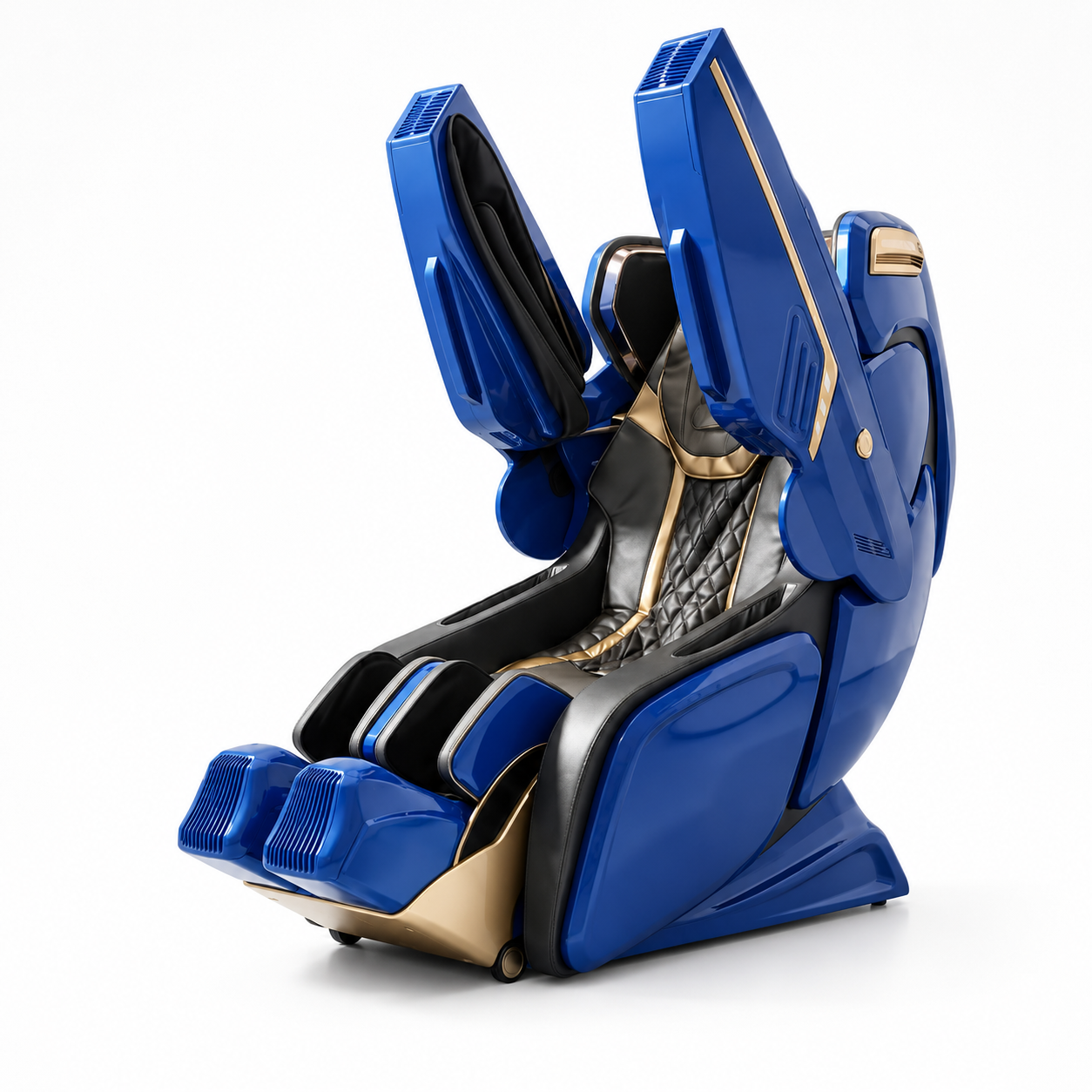
If older family members will use the chair, simple controls matter more than the number of programs. Voice control helps here: on every model in the table above you can say a command such as “start zero gravity” instead of looking for a button. Niyak, Rayan and Weltron also have fingerprint sensors that give readings about your general condition, such as pulse, before a session. Treat these as a general check-in, not a medical measurement.

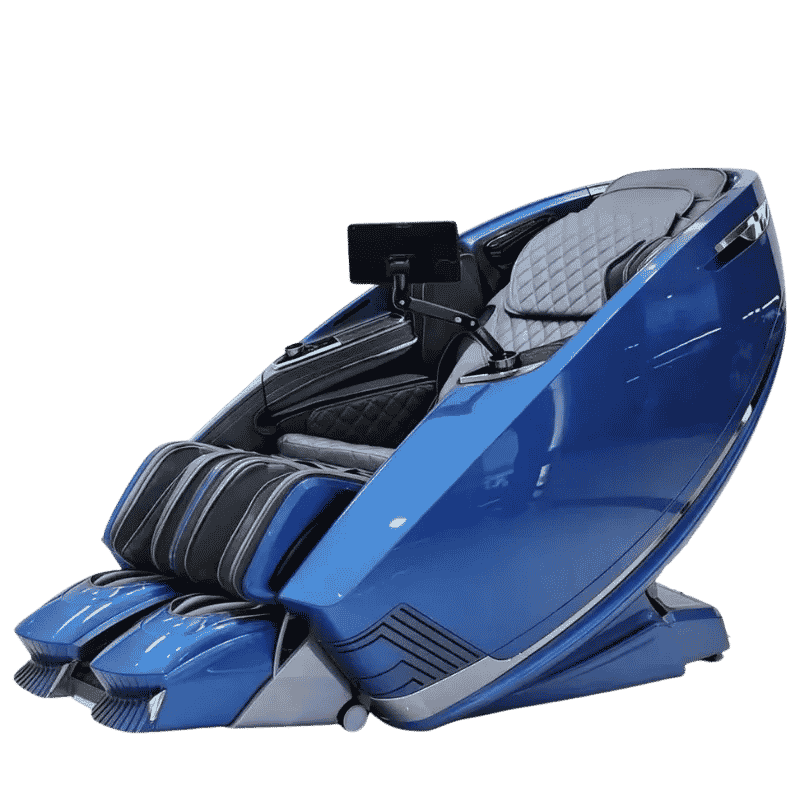
Niyak’s three control options: voice, touch screen and roller dial
7. Upholstery, color and upkeep
| Material | Pros | Cons |
|---|---|---|
| Leather | Durable, ages well, luxurious look and feel | Expensive, requires conditioning to avoid cracks, less breathable |
| Faux leather (PU/PVC) | Affordable, wide variety of finishes, easy to clean | Less durable, can peel or crack over time, not as breathable |
| Fabric | Soft, breathable, comfortable in warm climates | Stains more easily, harder to clean, less premium look |
Weltron uses silicone leather and Niyak uses PU leather. If the chair will sit in a living room, color matters too. Weltron and Auren can be ordered with 18-color custom panels; the other models come in their standard colors. Customization covers the body color only, not the interior or footrest finish. For upkeep, see how to clean and maintain a massage chair.

8. Budget, warranty and returns
Cheaper chairs usually save money on the mechanism: simpler rollers, fewer programs and a shorter track. Because a chair is used for years, compare the cost of ownership rather than the sticker price. Studies of home chairs point to lower ongoing cost than repeated clinic visits (research), which only holds if the chair keeps working.
That makes the policy pages part of the price. Some retailers charge a restocking fee of 15% plus shipping on returns (Furniture for Life), which can mean hundreds of dollars if a chair does not suit you. Questions worth asking any seller:
| Question | 360massage |
|---|---|
| How long is the warranty, and are parts free? | 3 years with free spare parts (warranty) |
| When does coverage start? | On the delivery date |
| How long do I have to return it, and what will it cost me? | 90 days, free return shipping, no restocking fee (returns) |
| Is delivery extra? | No, shipping is free |
| Can I spread the cost? | 24-36 monthly payments through Affirm, or Klarna at checkout (financing) |
9. Safety features
Look for an auto shut-off timer and sensors that stop the chair if something is in the way. Ayla, for example, has eight anti-pinch sensors and rear sensors that stop the chair’s movement when they detect an obstacle behind it. This matters most in homes with children or pets.
Things that I personally consider the most, if I want to buy my massage chair
People often ask me, “What should I look for when buying a massage chair?” The truth is, there are dozens of features you could consider, from Bluetooth speakers to cup holders, but in my experience, four key elements consistently determine whether a chair becomes a long-term investment or just an expensive novelty.

1. 4D Massage technology
As someone who has worked as a clinical massage therapist for years, I can tell you that the most important factor is whether the massage feels human. If the rollers move like a machine, the experience is wasted. That’s why I pay close attention to how well the 4D technology is executed. When it’s done right, with natural rhythm, variation in speed, and responsive depth, the massage chair stops feeling like a gadget and starts feeling like a skilled pair of hands.
2. Multi-user usability
In my home, I’m not the only one using the chair. My wife and kids use it too, and my older son, who’s a bit taller than me, especially enjoys it. For us, it’s critical that the chair adapts to different body types. A solid body scan system and adjustable settings make sure that I, my son, and anyone else in the family can sit down and have the chair fit them properly. Without that, the chair would just become a “dad-only” gadget, and that’s not the point.
3. Massage variety
I use the massage chair in different moods and after different activities. Some days I need recovery after being on my feet, other times it’s about winding down after work. That’s why I value chairs that offer a variety of techniques and programs, shiatsu, kneading, stretching, and even mood-based settings. It keeps the experience therapeutic, not repetitive, and helps me get exactly what I need depending on the moment.
4. Cost vs. longevity
Having worked in clinical massage and rehab, I know firsthand how much ongoing therapy can cost. Physiotherapy and regular massage sessions add up quickly, especially for long-term conditions. A high-quality massage chair, while expensive upfront, pays for itself over time if it performs well for years. I don’t just look at the sticker price, I look at whether the chair will hold up after hundreds of hours of use and whether the warranty supports that. In my view, the investment is worth it.
At the end of the day, there are plenty of bells and whistles out there, but if a chair feels right, adapts well, offers therapeutic range, and holds up over time, that’s when you’ve found something worthwhile.
What chair I use currently
It has now been almost a year since I started using the Niyak model from 360Massage, and I can honestly say it ticks all the boxes I just described. The massage feels natural, the chair adjusts effortlessly for different users in my family, and the range of techniques keeps the experience fresh.
What really sets it apart, though, is the fingerprint health check. With one touch, the chair measures my heart rate, blood oxygen, and other vital metrics before tailoring the massage accordingly. I haven’t seen this feature on any other chair, and for me as someone who values data-driven health insights, it has become indispensable.
It feels good, it works the way it should, and it delivers everything I was looking for, and that’s enough for me.


Design Your Chair Yourself