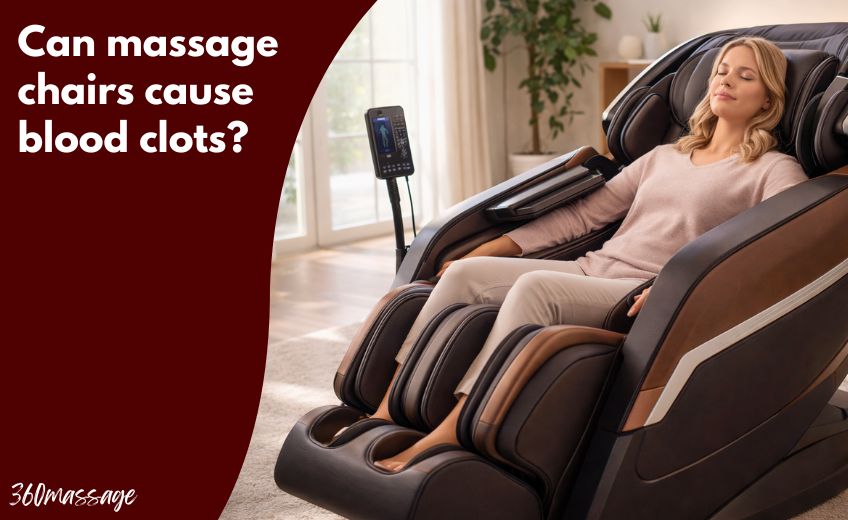
Can massage chairs cause blood clots?
Massage chairs are great at relaxing you and come with many medical benefits, but if somewhere between the kneading rollers and the calf compression, a common concern pops up: Can massage chairs cause blood clots?
The short answer is reassuring:
No, massage chairs do not typically cause blood clots in healthy individuals.
The longer, more honest answer:
They can be risky for people who already have a clot, especially one they don’t know about.
So no, your massage chair isn’t secretly manufacturing clots like a rogue factory. But like any strong mechanical therapy, context matters. Let’s walk through what medical science actually says, where the risks really are, and who should think twice before hitting “deep tissue mode.”
What are blood clots (and why do people worry about them)?
Blood clots form when blood thickens and clots together. This can be helpful, like when you cut your finger, but it can be dangerous when it happens inside a vein.

The most common concern related to massage is deep vein thrombosis (DVT), a clot that forms in the deep veins of the legs. If part of that clot breaks loose, it can travel to the lungs and cause a pulmonary embolism, which is a medical emergency.
That’s the nightmare scenario people associate with massage. But here’s the key distinction:
Massage doesn’t create clots.
Massage can, in rare cases, dislodge an existing clot.
That difference matters a lot.
What official medical sources actually say
Medical authorities don’t warn against massage chairs for the general population. Instead, they consistently emphasize contraindicated situations where massage should be avoided.
Guidance from the national center for complementary and integrative health (NCCIH)
According to the National Center for Complementary and Integrative Health, massage therapy is generally safe, but it should not be applied over:
- Known blood clots
- Deep vein thrombosis (DVT)
- Fractures or weakened bones
- Areas with inflammation or infection
They also note that rare serious side effects, including blood clots, have been reported almost exclusively in at-risk populations, such as older adults or individuals receiving very vigorous massage.
That’s an important nuance: the risk is not the massage itself, but the massage applied in the wrong context.

The Mayo Clinic lists blood-clotting disorders, use of blood thinners, and vascular disease as conditions where massage therapy should only be done after consulting a physician.
In other words, massage is a tool, not a universal solution.
What the medical literature shows
Case reports help explain where the fear comes from.
A documented case indexed by PubMed describes an older adult who developed venous thromboembolism following vigorous deep-tissue leg massage. The massage didn’t create the clot; it likely dislodged an undiagnosed one.
That detail matters.
These cases almost always involve:
- Deep, forceful massage
- The legs (especially calves)
- An existing but unrecognized DVT
- Older age or limited mobility
This is why legs get special attention in medical warnings. Most DVTs start there.
But isn’t massage supposed to improve circulation?
Yes, and this is where things get interesting.
Research associated with the National Institutes of Health suggests that gentle massage and movement can actually help reduce clot risk in certain situations, such as post-surgical recovery or prolonged immobility.
Light calf massage, walking, ankle pumps, and compression stockings are all commonly recommended to support venous return.
So, massage isn’t the villain. The issue is intensity, pressure, and automation.
Massage chairs don’t adapt the way a trained therapist does. They apply consistent, mechanical force, sometimes deeply, especially in the calves and thighs.
That’s fine for healthy users. It’s not ideal if a clot is already present.

Where massage chairs specifically fit into the risk picture
Massage chairs often include:
- Rolling mechanisms along the legs
- Air compression for calves and feet
- Repetitive, rhythmic pressure
- Deep-tissue programs by default
For most people, this is safe and beneficial. But massage chairs can’t assess medical risk.
They don’t know if you:
- Recently had surgery
- Sit for 10 hours a day.
- Take anticoagulants
- Have a clotting disorder.
- Have unexplained leg swelling or pain
A human therapist would stop. A chair will happily continue.
Who should be cautious (or talk to a doctor first)

You should get medical clearance before using an intense leg massage if you:
- Have a history of DVT or pulmonary embolism.
- Are on blood thinners
- Have known clotting disorders
- Are you recovering from major surgery
- Have significant mobility limitations
- Experience unexplained calf pain, swelling, redness, or warmth
If one leg looks like it’s been secretly training for a bodybuilding competition while the other hasn’t, skip the massage and call a doctor.
That’s not paranoia. That’s basic vascular awareness.

Design Your Chair Yourself