


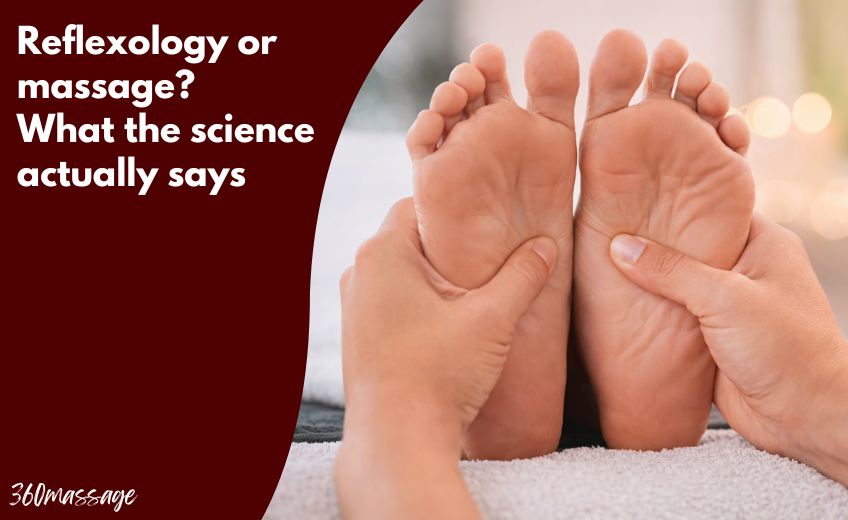
Reflexology or massage? What the science actually says
Walk into almost any wellness center, and you’ll see both options on the menu: reflexology and massage therapy. They’re often grouped together, priced similarly, and spoken about as if they’re interchangeable.
They’re not.
While both aim to help people relax and feel better, they work on very different principles, and science treats them very differently. One has decades of clinical research behind it. The other leans heavily on tradition, theory, and subjective experience.
This article breaks down what reflexology or massage really are, and how to decide which one actually fits your needs.
What is reflexology?
Reflexology is a practice that applies pressure to specific points on the feet, hands, or ears. These points are believed to correspond to organs and systems throughout the body. According to reflexology theory, stimulating these areas can influence health in distant parts of the body. Pressing the foot helps the liver; pressing the hand calms the lungs.
Here’s the key issue: those anatomical connections haven’t been scientifically demonstrated.
The U.S. National Center for Complementary and Integrative Health (NCCIH) classifies reflexology as a complementary practice, but notes that its proposed reflex maps are not supported by known physiology or neurology. In other words, there’s no established biological pathway connecting foot pressure points to internal organs in the way reflexology suggests.
That doesn’t mean reflexology does nothing. It does mean its mechanism of action remains unproven.

What is massage therapy?
Massage therapy works directly on muscles, connective tissue, fascia, and joints. Techniques like Swedish massage, deep tissue, myofascial release, and trigger point therapy manipulate soft tissue to reduce tension, improve circulation, and modulate the nervous system.
Unlike reflexology, massage therapy aligns closely with known anatomy and physiology. Pressure affects muscle tone, blood flow, lymphatic drainage, and pain signaling. These mechanisms are observable, measurable, and studied.
Massage at home
Massage has been so widespread and effective that people thought, ‘Why not get it at home whenever we want?’ That led to massage chairs. They are very effective and high-end models like Soma come with a variety of massage programs to choose from, giving you that relaxing massage from the comfort of your home.

Reflexology or massage: the actual differences
| Aspect | Reflexology | Massage therapy |
| Target areas | Feet, hands, ears | Muscles, fascia, joints (full body) |
| Scientific evidence | Limited, inconsistent | Pain relief, stress reduction, and circulation |
| Mechanism | Theoretical reflex maps | Anatomical and neurological |
| Proven benefits | Relaxation | Pain relief, stress reduction, circulation |
| Clinical use | Rare | Common in hospitals and rehab |
| Risk level | Very low | Low (higher with aggressive techniques) |
What does the evidence say about reflexology?
This is where expectations need to be realistic.
According to NCCIH, there is insufficient evidence to support reflexology as an effective treatment for most health conditions. Research examining reflexology for irritable bowel syndrome, asthma, cardiovascular disease, and chronic pain has not produced consistent or convincing results.
A systematic review published in the medical journal of Australia concluded that reflexology shows no reliable evidence of effectiveness for any specific medical condition, citing poor study design, small sample sizes, and inconsistent methodologies.
Some small studies suggest minor benefits in specific contexts, such as reduced shortness of breath in breast cancer patients or reduced tingling sensations in people with multiple sclerosis. However, these effects were modest and not clearly superior to relaxation alone.
In short, reflexology may feel calming, but its specific healing claims are not supported by strong scientific evidence.
Science behind the massage therapy
Massage therapy is far better supported, but still not magical.
NCCIH reviews indicate low-to-moderate evidence that massage provides short-term relief for:
- Low back pain
- Neck and shoulder pain
- Knee osteoarthritis
- Tension headaches
NIH-funded studies also show benefits for fibromyalgia, including reductions in pain, anxiety, and sleep disturbance when massage is used consistently over several weeks.
Importantly, most benefits are short-term, meaning massage helps manage symptoms rather than cure the underlying disease.
What are the risks of each one?
Reflexology is generally safe for most people, with minimal reported adverse effects. That said, it should be avoided in areas with open wounds, fractures, or severe circulatory issues.
Massage therapy is also considered safe when performed by trained professionals. Rare risks include bruising, nerve irritation, or complications in people with clotting disorders, osteoporosis, or recent surgery, especially with deep tissue techniques.
In both cases, medical conditions should be disclosed before treatment.

Which one should you choose?
Choose massage therapy if you:
- Have muscle pain, stiffness, or tension
- Are you recovering from surgery or injury
- Need evidence-backed symptom relief.
- Want a treatment grounded in anatomy.
Choose reflexology if you:
- They are primarily seeking relaxation.
- Enjoy foot-focused sessions
- Prefer a gentle, non-invasive experience.
- Understand it’s not a medical treatment.
Neither replaces medical care. Both work best as complementary tools, not cures.


