


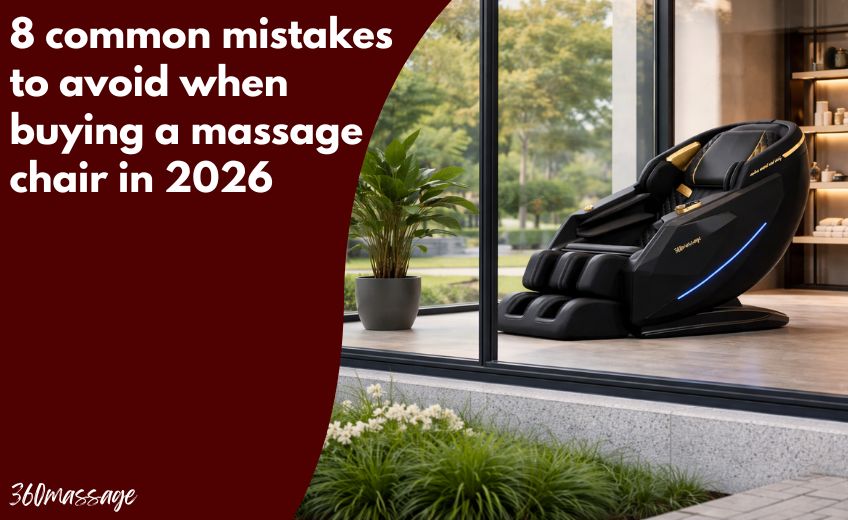
8 common mistakes to avoid when buying a massage chair in 2026
Massage chairs are great; they help relieve back pain, energize you, and improve your day. So, you want to buy one, and you think nothing can go wrong, but it can.
Buying a massage chair isn’t about chasing the lowest price or the longest feature list. It’s about long-term value, fit, durability, and whether you’ll actually use the chair three years from now.
Most buyers get this wrong in predictable ways. Here are the eight mistakes that cost people the most money and comfort over time.

What are the 8 mistakes you can make when buying a massage chair?
As good as massage chairs are, you have to be careful to avoid these mistakes to have the best shopping experience.
Buying on price alone
Cheap chairs look attractive until you live with them.
Entry-level models in the $2,000–$3,000 range usually cut corners where it matters most: smaller motors, limited roller travel, weaker airbags, and short warranties. Mid-range and premium chairs, often $7,000 to $19,000+, aren’t expensive because of branding; they’re expensive because they’re built to last and actually perform.

Why it matters
You may save upfront, but you’ll pay later in repairs, limited functionality, or full replacement. Total ownership cost often exceeds the sticker price.
How to avoid it
Set your budget after defining must-have features:
- Body scanning
- 3D or 4D rollers
- Zero-gravity positioning
- Multi-year parts and labor warranty
Then compare models within that framework.

Ignoring body size and room constraints
A massage chair that doesn’t fit your body or room is a very expensive mistake.
Chairs vary widely in height range, shoulder width, leg extension, and recline clearance. Some won’t fit through standard doorways. Others won’t accommodate taller or heavier users comfortably.
Poor fit leads to bad alignment, weak pressure, and awkward daily use. Eventually, the chair stops getting used.
Have these in mind:
- Measure doorways, hallways, and the final room.
- Account for recline clearance
- Check height and weight ranges.
- Use body-scanning demos when possible.
Overlooking long-term durability and warranty
Flashy features don’t mean much if the motor fails.
The heart of a massage chair is the motor system. Weak motors burn out early, especially with frequent use. Warranties reveal how confident manufacturers are in their build quality.
Repairs are expensive. Motors fail quietly and suddenly.
Always look for:
- Look for at least 3 years of parts and labor coverage.
- Prioritize reviews discussing long-term use, not first impressions.
- Pay attention to the motor duty cycle and service access.

Assuming “advanced tech” fits everybody.
Technology doesn’t automatically mean adaptability.
Some chairs pack features but lack proper adjustability for different torso lengths, shoulder widths, or leg proportions.
Misalignment causes pressure points, missed muscle groups, and discomfort, especially for shorter or larger users.
Choose chairs with:
- Accurate body scanning
- Adjustable shoulder, airbag, and leg zones
- Customizable intensity per area

Underestimating massage intensity and program quality
More programs don’t mean better programs.
Many chairs advertise dozens of modes but offer poor intensity control. The result is a chair that’s either too weak to be useful or too aggressive to enjoy.
If the intensity isn’t right, the chair gets ignored, no matter how many modes it has.
To avoid this:
- Test multiple intensity levels.
- Ensure smooth transitions, not abrupt pressure.
- Look for proven techniques such as kneading, rolling, tapping, and shiatsu.
- Read user reviews focused on comfort and effectiveness.
Usability beats marketing numbers.
Ignoring the total cost of ownership
The purchase price is only the beginning.
Maintenance, cleaning, replacement of airbags and rollers, and service calls add up over the years, especially on poorly built models.
A cheaper chair can cost more in the long run than a higher-quality one.
- Ask about routine maintenance requirements.
- Compare service plans and included coverage.
- Estimate annual upkeep
Buy with a five-year horizon, not a five-minute decision.

Skipping real-world testing
Spec sheets don’t tell you how a chair feels.
Firmness, seat depth, roller pressure, and body positioning are highly personal—and impossible to judge from photos alone.
Comfort is subjective. Guessing is risky.
So try to:
- Test in person whenever possible
- If buying online, choose retailers with real trial periods.
- Adjust the chair live, don’t rely on presets
If a retailer won’t let you test or return easily, walk away.
Ignoring personal health considerations
Massage chairs are powerful tools, not toys.
People with back issues, circulatory conditions, or mobility limitations need adjustable, controllable systems. Poorly matched chairs can worsen symptoms.
Incorrect pressure or roller placement can cause pain instead of relief.
You should always:
- Follow medical or physical-therapy guidance.
- Choose chairs with gradual intensity ramps.
- Ensure you can disable specific zones or features.
Bottom line
A massage chair isn’t a gadget; it’s a long-term investment in comfort and recovery. Buy with intention, test thoroughly, and think in years, not discounts.
That’s how you avoid regret in 2026.


