


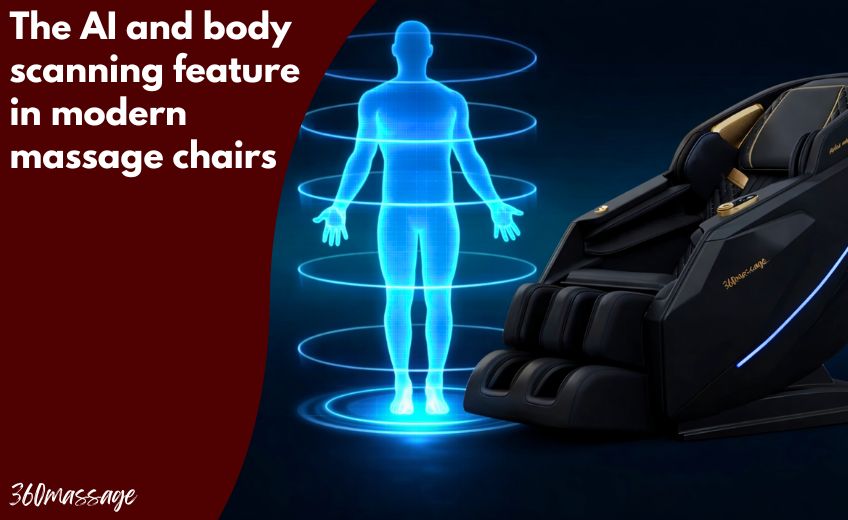
The AI and body scanning feature in modern massage chairs
When talking about AI, you might immediately think of ChatGPT or Gemini writing text, generating images, or the funny cat love stories in Instagram reels, but did you know that massage chairs use AI too?
For years, massage chairs used fixed programs and predefined routines designed to fit everyone, but in practice, they fit no one perfectly. But that is ending. Modern massage chairs like Niyak now integrate artificial intelligence (AI) and body-scanning technologies, enabling them to understand the user’s anatomy, detect muscle tension, and adjust massage techniques in real time.
By combining sensor-driven body data with adaptive algorithms, these systems move beyond automation. They aim to replicate something closer to human intuition, delivering a message that is not only more precise but also more responsive, personalized, and effective.
What is body scanning in massage chairs?
Body scanning is the backbone of personalization in modern massage chairs. Before the session even begins, the chair evaluates the user’s physical structure to determine exactly how its massage systems should engage.
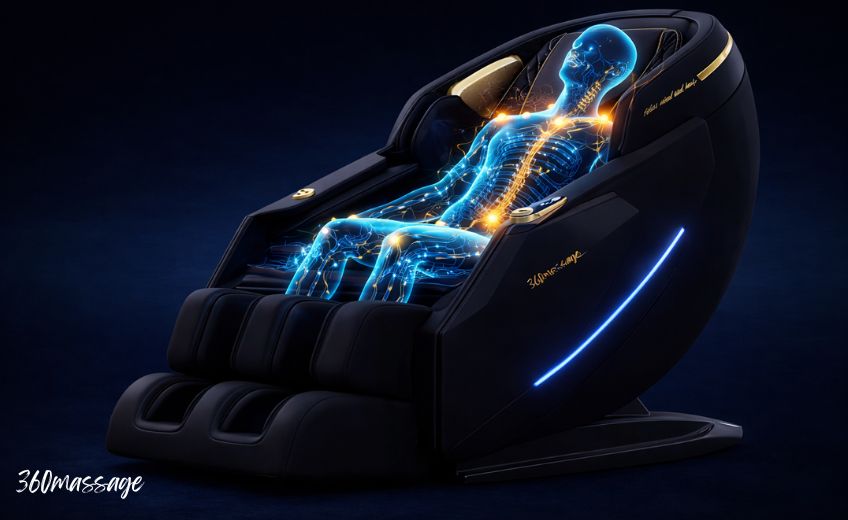
Instead of relying on generic body assumptions, the chair reads posture, proportions, and alignment. Rollers track the spine correctly. Airbags deploy where they’re needed. Pressure is applied with purpose.
This initial assessment isn’t a feature; it’s the prerequisite for comfort, safety, and real therapeutic impact.
How body scanning works
Body scanning systems rely on a combination of mechanical sensors, motor-resistance feedback, and positional tracking to construct a functional three-dimensional map of the user’s body.
The process isn’t visual; it’s physical. The chair learns through movement, resistance, and contact.
This scan typically captures:
- Spine length and curvature
- Shoulder height and width
- Arm and leg length
- Key pressure points along the back, hips, and shoulders
More advanced systems move beyond structure and begin reading tissue. As rollers travel along the spine, changes in motor load reveal variations in muscle stiffness and resistance in real time.
The chair responds immediately. Roller depth adjusts. Width recalibrates. Airbag pressure adapts.
The result is a massage that conforms to the body, rather than what a preset expects.
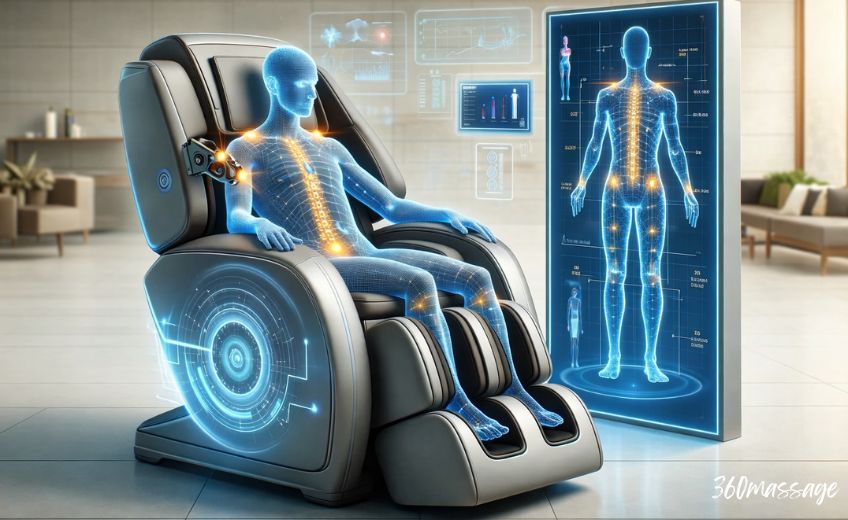
Precision targeting: Why scanning improves massage accuracy
Without body scanning, massage rollers move along a fixed vertical path. Pressure is applied evenly, not intelligently. The result is predictable: missed muscle groups, inconsistent contact, and discomfort, especially for users outside average height or body proportions.
With body scanning enabled, approximation is replaced by precision. The chair can:
- Dynamically adjust roller depth and width.
- Maintain consistent contact from the neck through the lower back.
- Apply stronger pressure to tense areas and lighter pressure where muscles are relaxed.
- Ensure symmetry across both sides of the body.
Many premium chairs extend personalization beyond a single session through user profile memory. Returning users are recognized automatically, and their preferred settings are restored without manual input.
Nothing needs to be reconfigured. The chair remembers.

What are AI-driven massage adjustments?
Body scanning supplies the anatomical data. AI handles the decisions.
It interprets the scan, then continuously refines the massage as the session progresses.
By analyzing both the initial body map and real-time feedback from motors and sensors, the system adjusts on the fly.
The massage adapts moment by moment, guided by data, not locked to a preset script.
What AI controls during a massage
AI algorithms can automatically regulate multiple variables throughout a session, including:
- Massage intensity and pressure
- Speed and rhythm of movements
- Technique selection (kneading, tapping, rolling, stretching)
- Focus areas based on detected tension, such as the neck, shoulders, or lower back
Instead of requiring the user to manually select programs or make adjustments, the system “samples” the body before and during the massage. It then optimizes the sequence in real time, responding to how the body actually reacts.
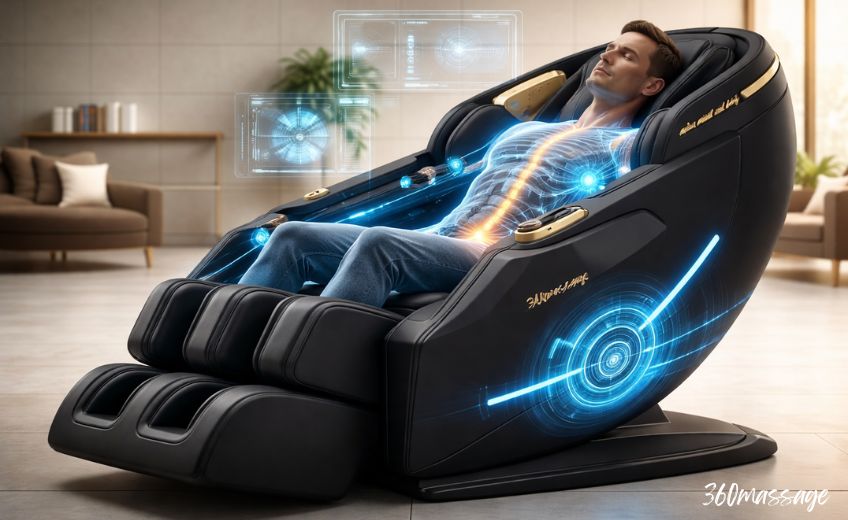
What clinical data shows about AI massage
AI-driven massage is no longer a theoretical upgrade. Clinical data now show measurable physiological effects.
In a 2025 crossover clinical trial, healthy adults underwent a 30-minute AI-guided massage protocol. Researchers evaluated outcomes using both objective and subjective markers, including EEG activity, heart rate, muscle tone, and sleep efficiency.
The results were unambiguous. The AI-guided “easy-sleep” protocol produced statistically significant relaxation responses: a 12% reduction in muscle tone, a 22% decrease in heart rate, and a 5.7% improvement in sleep efficiency following a nap. Neurological data also showed increased activation of the parasympathetic nervous system, an indicator of genuine physiological downregulation.
Intelligent massage as the new standard
AI and body scanning technologies represent a fundamental shift in how massage chairs operate. By combining anatomical mapping with real-time adaptive intelligence, modern chairs move beyond automation and into personalized wellness technology.
As clinical evidence expands and consumer adoption accelerates, intelligent massage systems are no longer a luxury novelty. They are rapidly becoming the standard for effective relaxation, recovery, and long-term comfort.


