What is a percussion massager? + 7 proven benefits
If you’ve ever seen someone aggressively jackhammering their thigh with a handheld device at the gym and thought, “is that a power tool or self-care?”, you’ve met a percussion massager.
Also known as massage guns, percussion massagers have become everyday wellness devices in a very short time. And for a good reason, there’s actual science explaining why they work and when they don’t.
This article breaks down what percussion massagers actually are, how they work, and 7 proven, research-backed benefits.
What is a percussion massager?
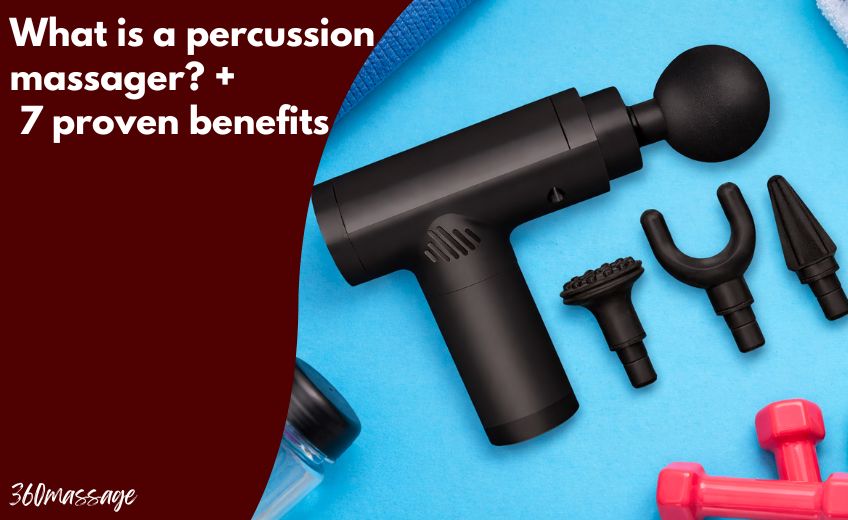
A percussion massager is a handheld recovery device that delivers rapid, repetitive pulses of pressure into muscles and surrounding soft tissue. Instead of gliding like a traditional massage, it strikes the tissue quickly and repeatedly, high-speed tapping rather than rubbing.
Most percussion massagers operate at frequencies between 20–60 Hz, meaning up to 60 pulses per second. They also vary in amplitude (the depth of the head’s penetration into the muscle) and come with different attachments to target specific muscle groups.
How does percussion therapy work?
When a percussion massager strikes muscle tissue, several things happen at once:
First, mechanoreceptors in the skin and muscles are stimulated. These receptors send signals to the nervous system that help reduce pain perception and lower muscle guarding.
Second, rapid pulses temporarily increase local blood flow, delivering oxygen and nutrients while helping remove metabolic waste, which is one of the reasons muscles feel less “heavy” afterward.
Third, repeated impacts help reduce muscle stiffness and alter neuromuscular activation. In other words, the muscle relaxes not because it’s being stretched, but because the nervous system stops telling it to stay tight.
This is why percussion therapy feels intense but often results in a surprising sense of looseness afterward.

What are the 7 proven benefits of percussion massagers?
These simple devices have many scientifically proven benefits, which is why they are so popular. Let’s break it down.
- Faster recovery from delayed onset muscle soreness (DOMS)
- Immediate flexibility and range of motion gains
- Reduced muscle stiffness and improved muscle quality
- Strength maintenance under fatigue
- Pain reduction
- Increased blood flow
- Performance optimization

Faster recovery from delayed onset muscle soreness (DOMS)
DOMS are the soreness that shows up 24–72 hours after a hard workout and makes stairs feel personal.
Multiple controlled trials show that longer percussion sessions (around 40 minutes total across muscle groups) significantly reduce pain scores compared to passive recovery or static stretching. These sessions also improved jump height, peak force, and knee range of motion, all markers of functional recovery.
In short:
Percussion therapy doesn’t just make soreness feel better; it helps you perform better sooner.
This benefit is especially useful for athletes, gym-goers, and anyone training multiple times per week.
Immediate flexibility and range of motion gains
Percussion massagers consistently show acute improvements in range of motion, especially in areas like the hamstrings, calves, hip flexors, and ankles.
Studies report 3–5 degrees of immediate ROM improvement in joints such as the ankle and hip, often with effects larger than those of foam rolling and without reducing muscle strength.
That’s a key point.
Unlike long static stretching, percussion therapy can improve flexibility without temporarily weakening the muscle, making it useful before and after training.

Reduced muscle stiffness and improved muscle quality
Muscle stiffness isn’t just uncomfortable; it affects force production and coordination.
Research shows percussion therapy can reduce stiffness in fatigued muscles, particularly in the calves and tendons.
This leads to improved contraction timing and smoother muscle activation patterns, both of which matter for performance and injury prevention.
This benefit is especially relevant for runners, jump-based athletes, and people prone to tight lower legs.
Strength maintenance under fatigue
One of the more interesting findings in recent studies is that percussion therapy can help maintain strength output during fatigue.
In controlled lab settings, participants who used percussion therapy between sets performed more consistent repetitions in exercises like the bench press and showed improved maximal voluntary contraction in the upper trapezius.
This makes percussion massagers useful not just for recovery, but also between training sets or during competitions.
Pain reduction
Percussion therapy has been shown to reduce self-reported pain, including chronic or subacute low back pain.
In one study, regular use led to a 16% reduction in back pain over two weeks, outperforming passive recovery methods. The mechanism is partly mechanical, partly neurological, decreasing pain signals while improving tissue tolerance.
This benefit is particularly valuable for desk workers, manual laborers, and people with non-specific back discomfort.

Increased blood flow
Manual massage increases circulation, but it takes time.
Percussion therapy has been shown to produce similar increases in blood flow in as little as 2 minutes, compared to 10–15 minutes of traditional massage.
This rapid response is useful when time is limited, for example, between workouts, during travel, or before competition.

Performance optimization
When applied briefly before activity, percussion therapy has been shown to improve explosive strength and reactive performance, as measured by jump tests and sprint-related metrics.
It does not significantly improve balance or agility, but for power-based movements, the nervous system “wake-up” effect appears real.
That makes percussion massagers useful for warm-up, not just cooldown.
The tool that hits back
Percussion massagers aren’t magic. They’re better than that; they’re mechanically simple, neurologically effective, and time-efficient.
They won’t replace hands-on therapy when you need it. They won’t fix everything. But they will help muscles relax faster, recover better, and perform more consistently, and science backs that up.
So, if you’re looking for a recovery tool that doesn’t require appointments, small talk, or an hour of your day, a percussion massager earns its place.
Just remember:
It’s not about hitting harder.
It’s about using the right pressure, in the right place, for the right reason.
Your muscles will notice.

Design Your Chair Yourself